19 business analysis documents, blank and filled in on one case
From the brief to the change request, with every rule traced to the law, the guidance or a logged decision.
For analysts who need to show their work: in an interview, in a portfolio, or on a first rules-heavy project.
Checkout opens on Polar. After you pay, you come back here and the library opens at once, with the ZIP to download.
- Read all 19 documents online, from the minute you pay
- Download the ZIP: 56 files, Word, Excel, PNG and .drawio
- Every ID linked across the set, with a search
- 14 days to ask for a refund, no questions asked
Two documents open before you buy: 03, the brief, in full, and 21, the review exercise, without its answer key.
USD 29. In the United States, Canada and India, tax is added at checkout; everywhere else, the price includes it. Polar, the merchant of record, works out the tax from your billing address. Law and guidance as read on 29 September 2026.
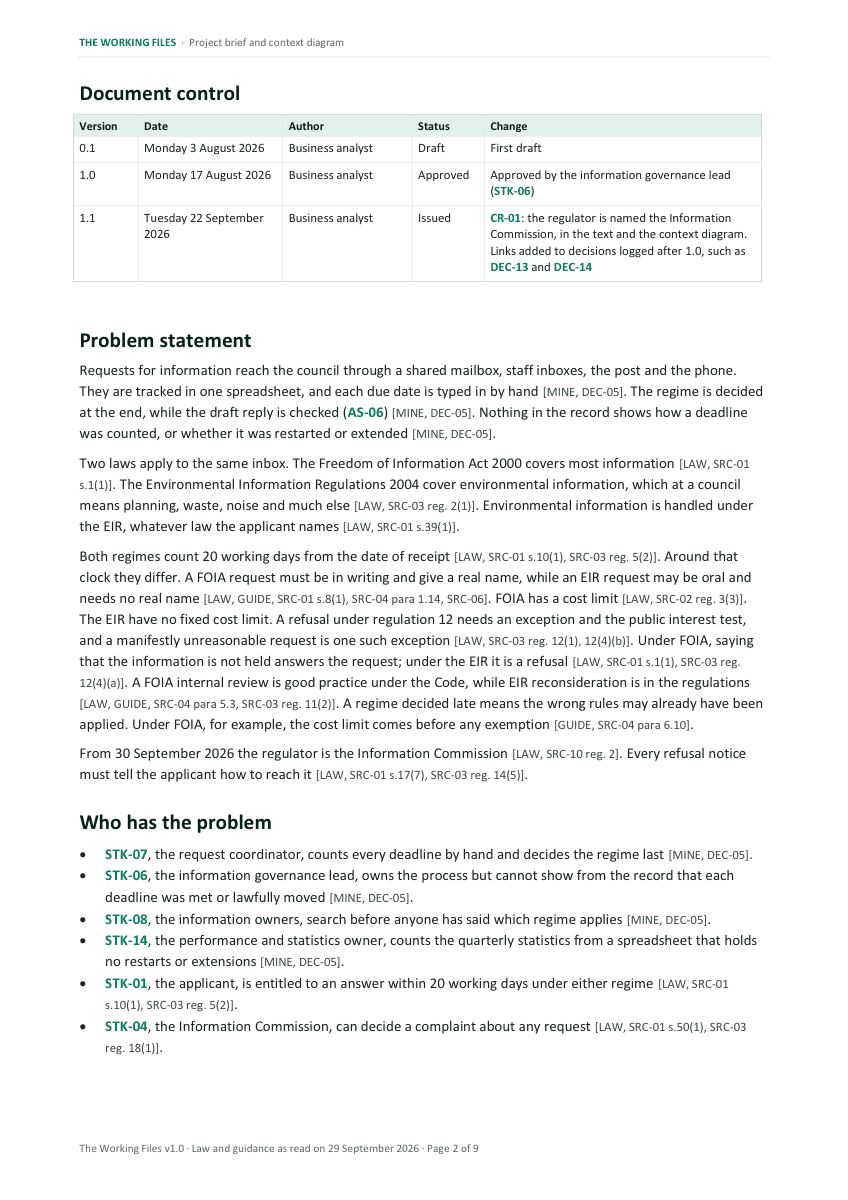
The documents fit together, among them the stakeholder register, the business rules, the decision tables, the requirements, the user stories, the business requirements document, the UAT test cases and the traceability matrix.
The case is a council in England handling requests for information under two laws. The council is fictional and unnamed. The law, the guidance and the calendar are real, and each is cited. You do not need to know UK law: every rule taken from the law or the guidance is quoted word for word, with its source.
 Written by Sebastian Koczyk, a business analyst on international projects since 2014 (CBAP). About the author
67 business rules · 4 decision tables · 37 requirements in the register · 28 UAT test cases · 47 rows in the traceability matrix · 5 diagrams
The files, as they print
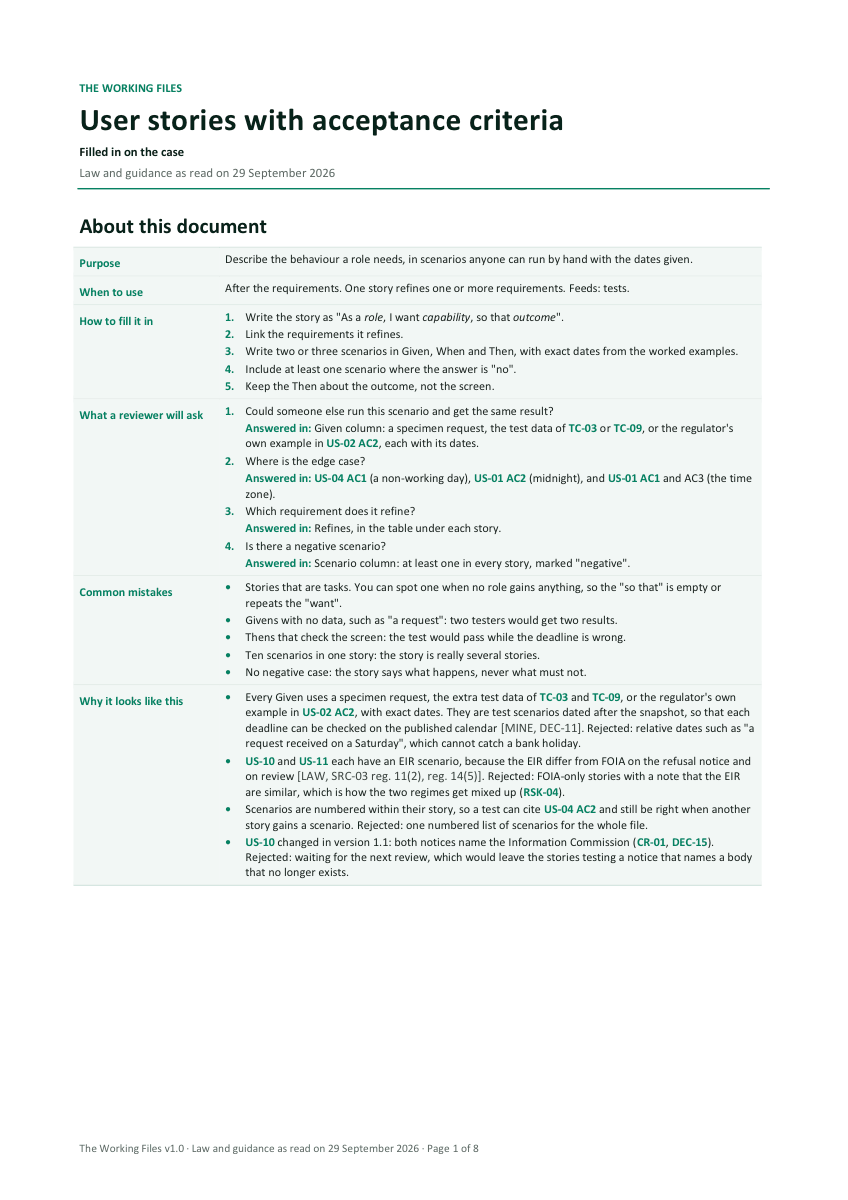
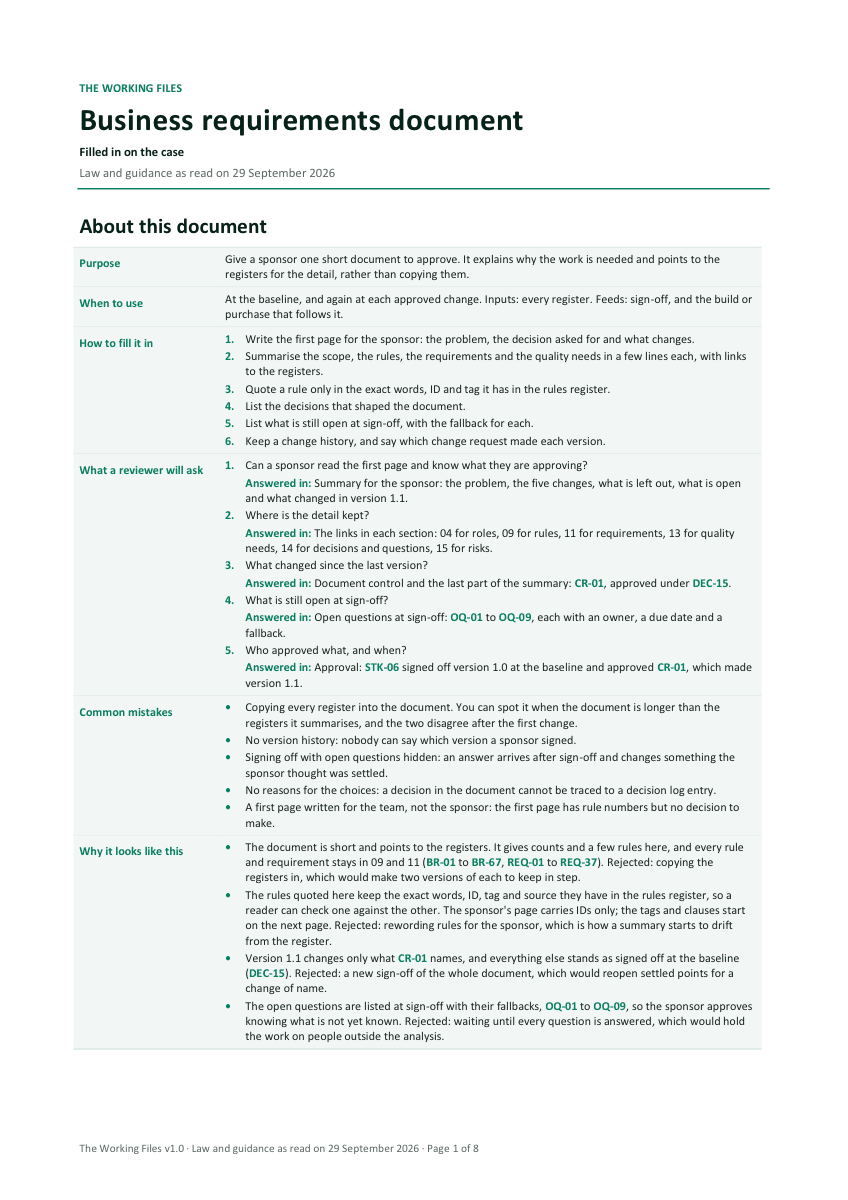
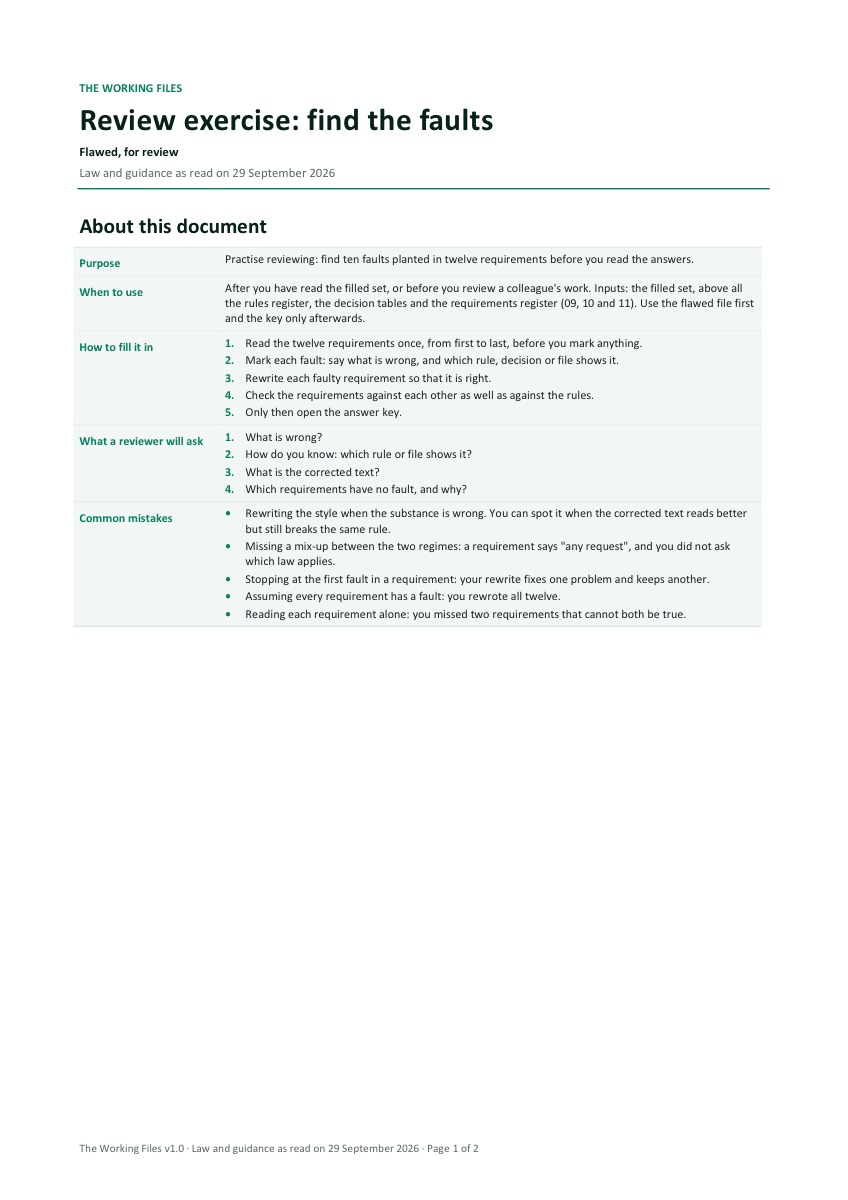
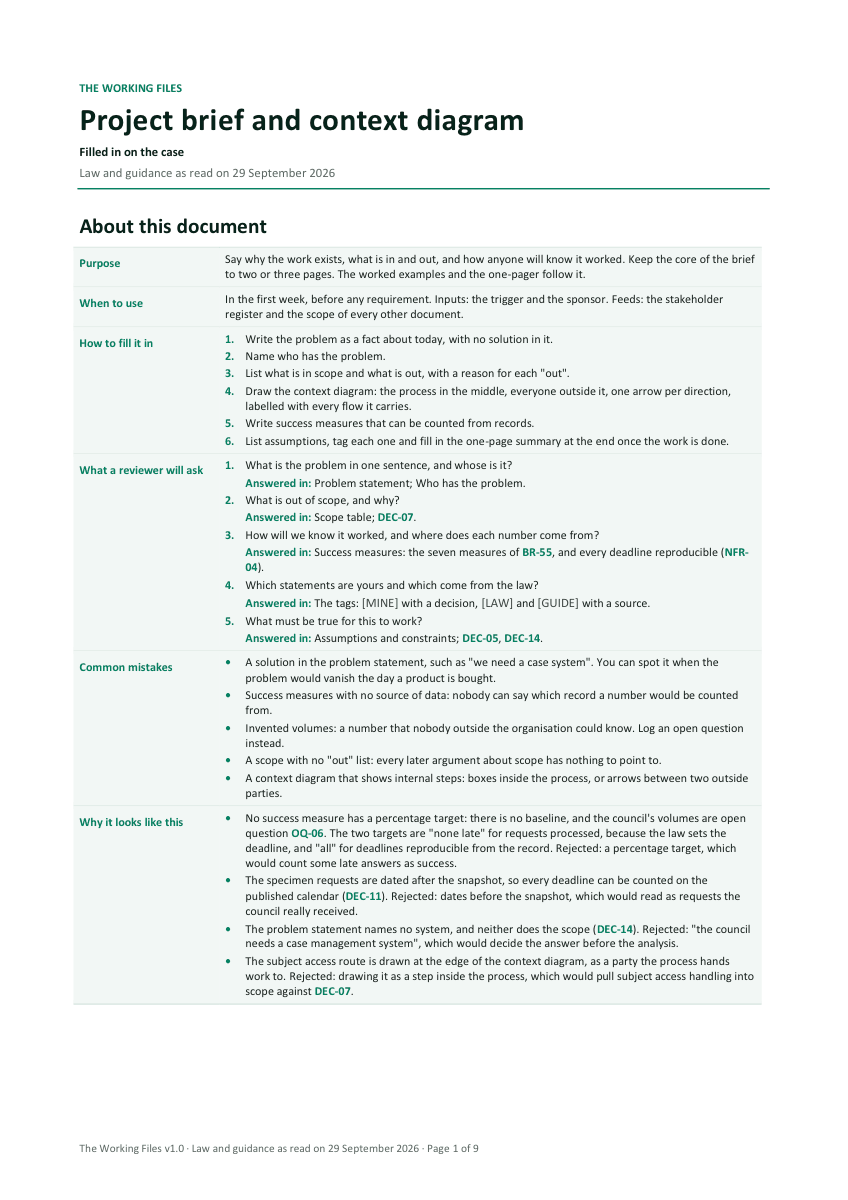
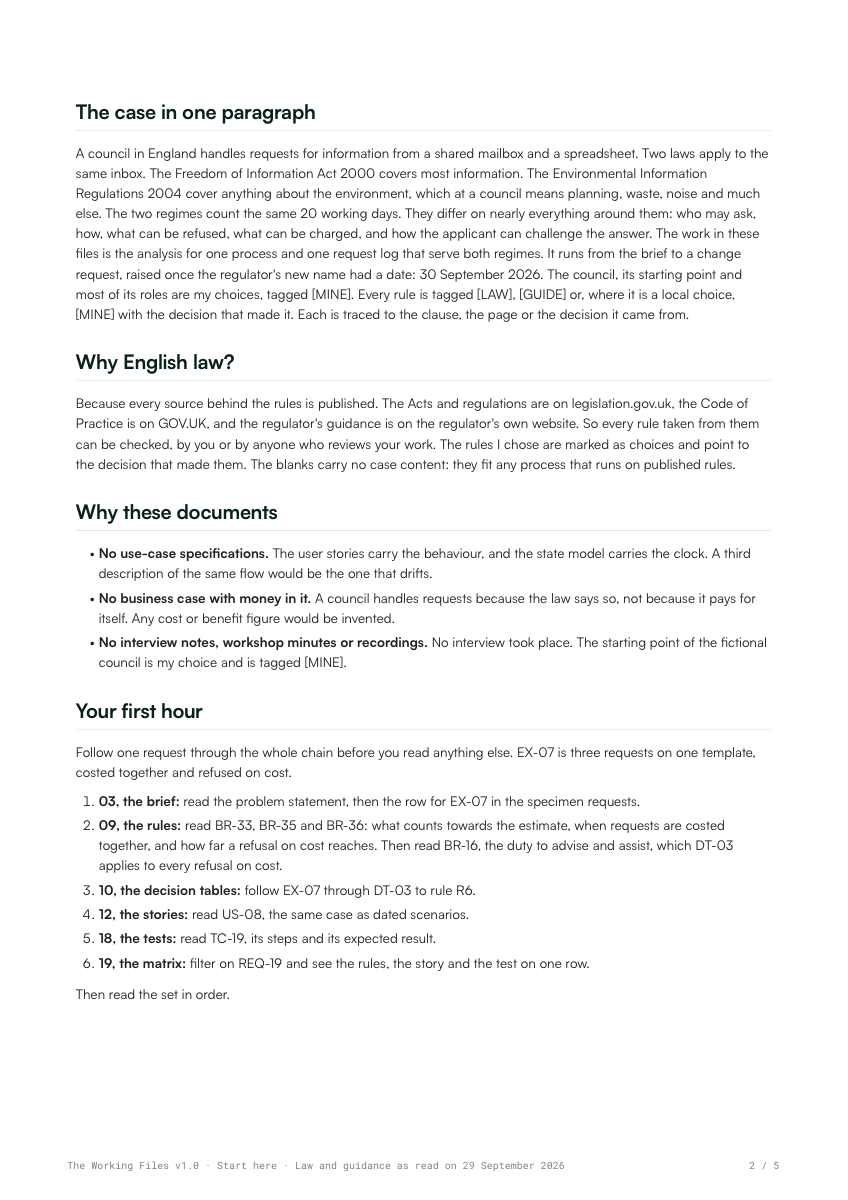
Every picture is a page of a file from the ZIP you download, as the document prints. None of them is a mock-up. Two documents open before you buy: 03, the brief, in full, and 21, the review exercise, without its answer key.
Analysts who need to show their work
- Analysts who need to show their work: in an interview, in a portfolio, or on a first rules-heavy project. The filled set shows what finished work looks like; the blanks and the review exercise are how you produce and defend your own.
- Analysts who have seen templates but never a finished, consistent set: one case, one set of IDs, every document pointing at the others.
- Working analysts who want blanks they can use at work tomorrow, with the reviewer's questions already written on the first page.
- Analysts moving into public-sector or regulated work, where every rule has an owner and a clause number.
Who made these files
I am Sebastian Koczyk. I have worked in business analysis since 2014, on international projects, as an analyst, a lead and a product owner, and I hold the CBAP. The filled files are my work on a fictional case.
On 11 September 2026 I hosted Wielki Feedback vol. 2 in Warsaw, a one-day conference where 130 people worked the same case. I had sent in my own analysis of that case anonymously, and it placed third.
19 documents in the order the work is done
Each row opens the document in the online library. 03 is free to read in full, and so is the flawed version of 21; its answer key comes with the set. Every other document shows its About page before you buy: what it is for, when to use it, how to fill it in, what a reviewer will ask and the common mistakes.
03-08Frame
09-13Specify
14-21Assemble and check
To find your way around
- 00-README.txt
- 01-START-HERE.pdf
- 02-INDEX.pdf
Every document opens with a page addressed to you (in the Excel files, the "How to use" sheet). It says what the document is for, when to use it and how to fill it in, then lists what a reviewer will ask and the common mistakes. In the filled version, each reviewer's question points to where the document answers it, and a final section explains why the document is built the way it is.
02-INDEX.pdf lists every file and every ID, and shows where each ID appears. Online, the same index is a page: every ID opens a card with its definition and the places it is used. The review exercise is twelve requirements with ten planted faults. The answer key is a separate file.
One council, two laws, one request log
A council in England handles requests for information from a shared mailbox and a spreadsheet. Two laws apply to the same inbox: the Freedom of Information Act 2000 for most information, and the Environmental Information Regulations 2004 for anything about the environment. At a council that means planning, waste, noise and much else. The two regimes count the same 20 working days. They differ on nearly everything around them: who may ask, how, what can be refused, what can be charged and how the answer can be challenged.
The files hold the analysis for one process and one request log that serve both regimes. It runs from the brief to a change request, raised once the regulator's new name had a date: 30 September 2026.
The council, its starting point and most of its roles are my choices, tagged [MINE]. Every rule carries a tag: [LAW], [GUIDE] or, for a local choice, [MINE] with the decision that made it. Each is traced to the clause, the page or the decision it came from.
Why English law?
Because every source behind the rules is published. The Acts and regulations are on legislation.gov.uk, the Code of Practice is on GOV.UK, and the regulator's guidance is on the regulator's own website. So every rule taken from them can be checked, by you or by anyone who reviews your work. The rules I chose are marked as choices and point to the decision that made them. The blanks carry no case content: they fit any process that runs on published rules.
Why these documents
Three things you might expect are left out on purpose.
- No use-case specifications. The user stories carry the behaviour, and the state model carries the clock. A third description of the same flow would be the one that drifts.
- No business case with money in it. A council handles requests because the law says so, not because it pays for itself. Any cost or benefit figure would be invented.
- No interview notes, workshop minutes or recordings. No interview took place. The starting point of the fictional council is my choice, and it is tagged
[MINE].
Four tags
[GUIDE] is used only in these files. The tags used elsewhere on this site are explained on the method page.
Seven things it is not
- Not legal advice. It shows analysis on rules you can check, as they were read on 29 September 2026.
- Not a course, and not preparation for any certification.
- Not a library of 150 templates. It is 19 documents that fit together.
- Not a real council's documents. The council is fictional and unnamed.
- Not about Scotland. Scotland has its own law and its own regulator.
- Not updated and not supported. They are a snapshot, and the date is printed in every document.
- No AI prompts. No interview transcripts or meeting notes either: no interview or meeting took place, and none is invented.
For one person
The licence is for one person. Use the files in your own work, including paid work for a client or an employer. Change them, copy parts into your own documents and keep copies for yourself.
Do not share, upload or publish the files, whole or in large part, in their original or an edited form. Do not sell or give them away as templates, and do not let anyone else use your copy. A team buys one copy per person. Documents you produce with the templates for your own work are yours.
Quotations from legislation and official guidance are public sector information under the Open Government Licence v3.0. This licence does not restrict what the Open Government Licence allows. The terms in full.
14 days, no questions asked
If the files are not what you expected, email hello@analify.com within 14 days of your order. Write from the address you used to buy, or add the order number from Polar's receipt. You get a full refund, no questions asked.
If you cannot read the files on analify.com or download the ZIP, there or from Polar's customer portal, email me and I will refund you in full, also after the 14 days.
Polar issues the refund to your original payment method, and your access to the library and the download ends when the refund is issued. The refund policy in full.
Nine answers
I do not work in the UK, or in the public sector. Is it still for me?
You do not need to know UK law. Every rule taken from the law or the guidance is quoted word for word, with its source and the date the source was last checked. What you practise is the analysis: routing, validity, the clock, the decision tables and the traceability. The blanks carry no case content: they fit any process that runs on published rules.
Is it just a set of templates?
No. It is 19 documents that fit together on one case: one set of IDs, every document pointing at the others. Each comes blank and filled in, except the review exercise, which comes as a flawed version and its answer key. Every document opens with a page that says what it is for, how to fill it in and what a reviewer will ask.
How is this different from the free Proof Pack?
The Proof Pack is six blank templates and one worked case, a returns process at a mid-size retailer, sent as one PDF. The Working Files are 19 documents on a different case, blank and filled in, as Word, Excel and .drawio files you can change, with a library online where every ID is linked across the set. The Proof Pack is free.
Can I use them at work, or show them in a portfolio?
At work, yes: the licence covers your own work, including paid work, and you can change the files as much as you like. In a portfolio, show a case of your own built on the blanks. The filled files are my work on a fictional case: presenting them as yours would prove nothing, and the licence does not allow publishing them. 01-START-HERE.pdf shows how to build a case of your own and how to present it in five minutes.
What do I download, and what opens it?
One ZIP with 56 files, one folder per document. The documents are Word and Excel files. The five diagrams come as PNG images and as .drawio files for draw.io (diagrams.net). The two guides are PDFs and the README is plain text. I have not tested Google Docs, Google Sheets, Numbers or LibreOffice, so I cannot promise the files work in them.
Where do the files arrive?
On analify.com, straight after you pay. Polar takes the payment and sends you back here: the library opens at once, with the ZIP to download and every document to read online. The confirmation email carries a one-time sign-in link for another browser or device, valid for 7 days, and Polar's customer portal at polar.sh/analify/portal holds a copy of the ZIP. There is no password to set and no account to create: a link from the email signs you in, in up to three browsers at a time, and the sign-in page sends a fresh one when you need it.
Will the files be updated?
No. They show the law and guidance as read on 29 September 2026, including changes already made in law that took effect on 30 September 2026. From that date the regulator is the Information Commission. The files use the new name, and change request CR-01 shows how the change was handled. The calendar in the test cases ends on 26 December 2028, the last date on the GOV.UK list when I checked it on 29 September 2026.
Who sells it, and can I get a VAT invoice?
Polar Software, Inc. sells it as the merchant of record. Polar charges the tax that applies where you are and issues the receipt. In its customer portal you can add a company name and a VAT number to the invoice and download it.
Can I read it on my phone?
Yes. The library works in any current browser, and the wide registers scroll sideways with the ID column kept in view. Your reading progress stays in that browser.
Read two documents first, or buy the set
03, the brief, opens in full, and 21, the review exercise, opens without its answer key. Every other document shows its About page before you buy.
One payment, for one person. 14 days to ask for a refund, no questions asked.
Sold by Polar Software, Inc., the merchant of record. Terms · Refund policy · Privacy · Questions about an order: hello@analify.com